|
A Little Love for the Cortina 3070
Restoring an example from an Eico product line which deserves more love. Plus, coverage of mods to improve low frequency stability, power, bias current, phono response and line-stage noise. Also covers substitution of available (and more robust) power transistors.
I’m not really sure why it was that the Eico Cortina was snubbed by the young audiophiles (once known as “hifi nuts”) that I knew back in the sixties. I detected an air that people thought Eico had “sold out” to outsourcing the kits to the far east. I don’t know of any evidence for that, though. The transistors are all U.S.-made (RCA) and the electrolytics don’t show asian markings. In this article, I will highlight in orange (a color for hot-button items), factors which may have negatively influenced opinion, sometimes unfairly. I will highlight in green (the color of money), architectural choices which Eico engineers used to make the Cortina line as cost-effective as possible.
Eico introduced its first solid-state hifi product, the 3566 receiver, in the 1965 catalog. I doubt that it fared well competitively and didn’t propagate into a product line. The power amp section was an earlier design using driver transformers and point-to-point wiring. No other solid state hifi products appeared for two years.
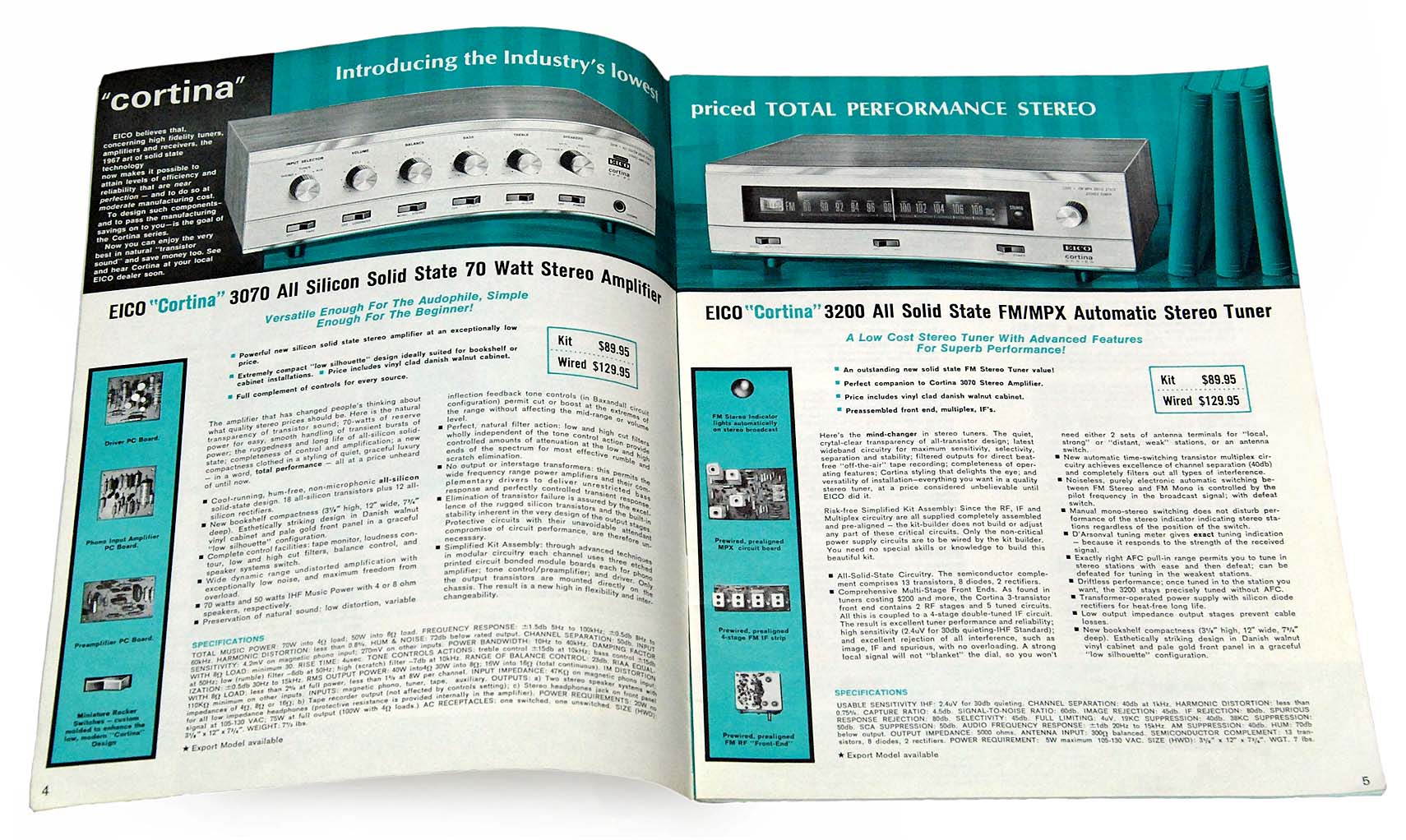
They introduced the Cortina line in the 1967 catalog (below) and that is what I think of as Eico’s first solid-state hifi. The series was designed for price-performance, where the 3566 was weak, so they had apparently learned a lesson from the first experience. Perhaps they learned it a little too well.
The initial offerings in the new line consisted of the 3070 “70-Watt” stereo amplifier and the 3200 FM Stereo tuner. With the 3070 kit-priced at just $89.95, it was clear that Eico was determined to be competitive. In test equipment, they had long staked out the “laboratory precision at lowest cost” ground. Now they wanted to claim similar turf in the hifi arena. One thing that irked stereophiles back in the day was that Eico started using the IHF system of rating amplifier power, about this time. Technical people often thought that it was simply a way to inflate the numbers. To Eico’s credit though, they also gave the RMS power spec, which is 15W per channel into 8-ohms (20W into 4-ohms). Not much you say? Hey it can kick an EL84 amp’s butt at 20Hz, and those go for big bucks on eBay, these days! Click here to see the full specifications.
 A test report on the Cortina 3070 appeared in the December, 1967 issue of Stereo Review magazine and you can read that here. Bear in mind that it was common practice then for reviewers to go easy on the foibles of products, to avoid offending potential advertisers. You had to “read between the lines” to discover what the reviewer really thought. All things considered, though, it seemed that Julian Hirsch thought that even the stock Cortina performed decently. Nevertheless, some of the mods discussed here are absolutely necessary to bring the amp up to good performance. Fortunately, most are easily accomplished. A test report on the Cortina 3070 appeared in the December, 1967 issue of Stereo Review magazine and you can read that here. Bear in mind that it was common practice then for reviewers to go easy on the foibles of products, to avoid offending potential advertisers. You had to “read between the lines” to discover what the reviewer really thought. All things considered, though, it seemed that Julian Hirsch thought that even the stock Cortina performed decently. Nevertheless, some of the mods discussed here are absolutely necessary to bring the amp up to good performance. Fortunately, most are easily accomplished.
 Limiting the power to 40W total is the first, cost-cutting decision. That reduced costs in the output and driver transistors, as well as the power supply and heatsinking. Yes, making it a 100W amp would have been a more impressive spec. The fact is though, that would only make a loudness difference of 4dB, which isn’t that much in the real world. It turns out that the 3070 can drive my not-so-efficient AR9 speakers to quite loud levels. I was very impressed with how well the amp did with Pink Floyd’s Dark Side of the Moon. It really delivered a clean and exciting performance. Bass is very strong and transients are crystal clear. How ’bout that space-age transistor sound, with its crisp highs and rock-solid bass? (Meant a bit whimsically. First U.S. manned space launch, at right.) Limiting the power to 40W total is the first, cost-cutting decision. That reduced costs in the output and driver transistors, as well as the power supply and heatsinking. Yes, making it a 100W amp would have been a more impressive spec. The fact is though, that would only make a loudness difference of 4dB, which isn’t that much in the real world. It turns out that the 3070 can drive my not-so-efficient AR9 speakers to quite loud levels. I was very impressed with how well the amp did with Pink Floyd’s Dark Side of the Moon. It really delivered a clean and exciting performance. Bass is very strong and transients are crystal clear. How ’bout that space-age transistor sound, with its crisp highs and rock-solid bass? (Meant a bit whimsically. First U.S. manned space launch, at right.)
 Perhaps the most unusual thing about the 3070 is its small size. At left, it’s dwarfed by an unabridged dictionary. At just about 3 x 12 x 8 inches, it can easily fit on a standard bookshelf. For some reason, since the early HF-series, Eico had often striven to make their audio components compact. Certainly there were many exceptions but there is no doubt that, with the slant-mounted tubes of the HF-12, HF-81, HFT-90 and similar products, they were trying to make them small. With the advent of transistors, they were freed to push this to a new level. I can’t say that I have ever seen another vintage “full power” hifi amp, that compact. For example, they went to the trouble of hanging the power transformer down below the chassis surface, to minimize overall height. Perhaps the most unusual thing about the 3070 is its small size. At left, it’s dwarfed by an unabridged dictionary. At just about 3 x 12 x 8 inches, it can easily fit on a standard bookshelf. For some reason, since the early HF-series, Eico had often striven to make their audio components compact. Certainly there were many exceptions but there is no doubt that, with the slant-mounted tubes of the HF-12, HF-81, HFT-90 and similar products, they were trying to make them small. With the advent of transistors, they were freed to push this to a new level. I can’t say that I have ever seen another vintage “full power” hifi amp, that compact. For example, they went to the trouble of hanging the power transformer down below the chassis surface, to minimize overall height.
Personally, I think it was a marketing miscue. It’s harder for people to take such a small component seriously. When guys were showing off their hifi gear, they wanted something big and powerful! Arr Arr :) Whether or not it was a good marketing move, it is certainly true that the smaller chassis cost less to make.
I have long suspected that people would be shocked, if they only knew how much of an amplifier’s cost was going into fancy packaging. I would not be surprised if 20-50% of the materials cost of products such as the Eico 685 transistor tester and the Heathkit AA-21 amplifier went into the chassis and case work. Some might think that wasteful but it was a truism that looks were extremely important in selling these products. They had to look impressive in the catalog.
With its emphasis on cost-effectiveness, little was spent on making the poor Cortina look pretty. This Cinderella didn’t have a fairy godmother to provide a nice dress and shoes.  The top cover (at right) was steel sheet metal, clad with wood-tone vinyl. Ventilation in back was provided by simply reducing the size of the back cover, leaving a gap around the side and top edges. One has to admit that the wood-tone vinyl and partially open back look, well, economical. Now, in all fairness, please note that I install the case with front and back reversed. This puts the flange at the front, where it keeps the top edge straight and even with the top of the front panel plate. If the flange were in back, it would look better back there. Bear in mind though, that the back would only be seen during installation. In most cases, where the unit is in a small shelf or cabinet, the top and sides would not be very visible, either. If ever there were a good place to cut, this is it. The top cover (at right) was steel sheet metal, clad with wood-tone vinyl. Ventilation in back was provided by simply reducing the size of the back cover, leaving a gap around the side and top edges. One has to admit that the wood-tone vinyl and partially open back look, well, economical. Now, in all fairness, please note that I install the case with front and back reversed. This puts the flange at the front, where it keeps the top edge straight and even with the top of the front panel plate. If the flange were in back, it would look better back there. Bear in mind though, that the back would only be seen during installation. In most cases, where the unit is in a small shelf or cabinet, the top and sides would not be very visible, either. If ever there were a good place to cut, this is it.
Nevertheless, Eico must have sold a good many of the products, since the line continued for a long time, still appearing in the 1975 catalog (but gone by 1978). Cortina’s often show up on eBay.
Why am I interested in the 3070? Good question. It certainly represents a first-generation silicon transistor amplifier and Eico’s first solid-state integrated amp. Perhaps I wonder whether there was really anything wrong with it and want to find out for myself. Maybe it’s because I grew up reading about quasi-complementary power amp circuits in Wireless World. Maybe it’s the retro audio project I saw in Elektor magazine recently, based on a similar sixties amp design. I guess it’s all of those things and more.
In any case, the 3070 represents Eico’s first big attempt to get into solid-state hifi and I would like to understand that better. Why didn’t Eico make it as proportionately big as Heathkit did in that area?
Rescuing an Orphan
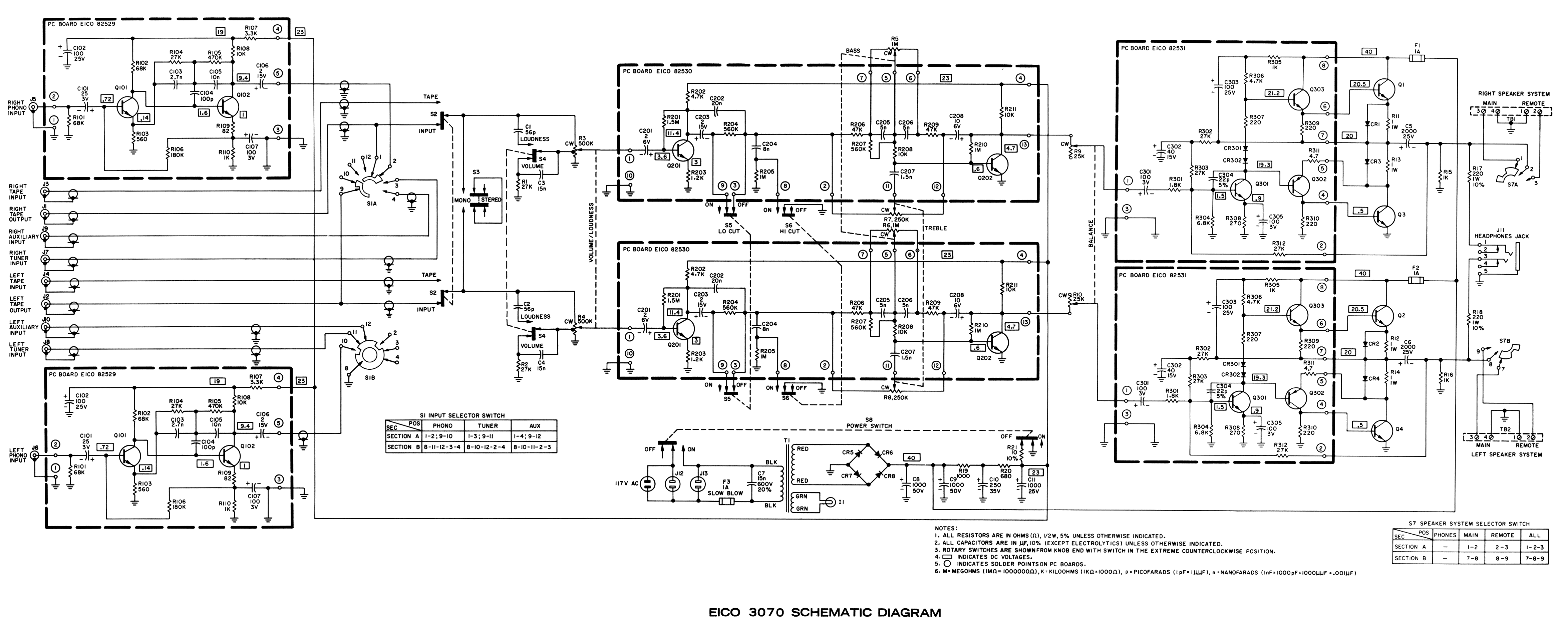
To find out more, I purchased a Cortina 3070 on eBay, where it went for just $25 (July, 2011, non-working condition and missing knob caps–new caps below). For a complete schematic, click on the thumbnail above.
How the Power Amp Works
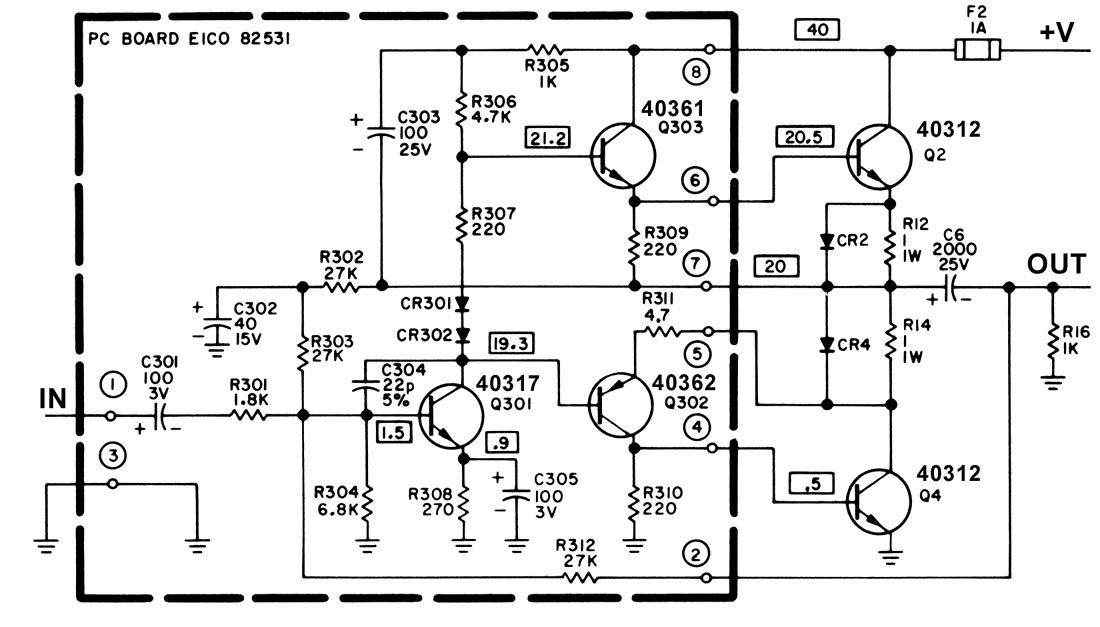
 Before going on with the restoration, let’s take a moment to discuss how the power amplifier works. Click on the thumbnail at left to see the schematic. We will begin at the output and work our way back. It is powered from a single, +45V power supply (marked +40V on the schematic). That requires output coupling cap C6 to keep DC out of the speaker. Single-ended power supplies are thought of as being cheaper than bipolar supplies but actually there is little difference in cost. An extra power supply filter cap in the bipolar approach trades off with the coupling caps in the other. The real cost savings is in amplifier circuitry. It would not be practical to use the five-transistor power amp circuit with a bipolar supply. That would put the input reference point at the negative rail, where it would suffer from power supply ripple. At the very least, an input differential amplifier circuit would be needed, adding two transistors. Downsides of the single-ended approach are the turn-on thump one hears in the speakers and potentially reduced low-frequency output power. Before going on with the restoration, let’s take a moment to discuss how the power amplifier works. Click on the thumbnail at left to see the schematic. We will begin at the output and work our way back. It is powered from a single, +45V power supply (marked +40V on the schematic). That requires output coupling cap C6 to keep DC out of the speaker. Single-ended power supplies are thought of as being cheaper than bipolar supplies but actually there is little difference in cost. An extra power supply filter cap in the bipolar approach trades off with the coupling caps in the other. The real cost savings is in amplifier circuitry. It would not be practical to use the five-transistor power amp circuit with a bipolar supply. That would put the input reference point at the negative rail, where it would suffer from power supply ripple. At the very least, an input differential amplifier circuit would be needed, adding two transistors. Downsides of the single-ended approach are the turn-on thump one hears in the speakers and potentially reduced low-frequency output power.
Since high quality PNP output transistors were more expensive at the time, they used a quasi-complementary output stage. This circuit replaces the PNP Darlington, with a complementary Darlington (Sziklai pair), as seen at right. Either connection acts a lot like a single transistor, with the beta being the product of the two individual betas. However, using a complementary Darlington in the bottom side of the amp makes both output transistors (Q2 and Q4), NPN. While a full complementary stage would have been more symmetrical (theoretically reducing even-order distortion), Eico was able to achieve a very respectable figure of about 0.25%, anyway. Either connection acts a lot like a single transistor, with the beta being the product of the two individual betas. However, using a complementary Darlington in the bottom side of the amp makes both output transistors (Q2 and Q4), NPN. While a full complementary stage would have been more symmetrical (theoretically reducing even-order distortion), Eico was able to achieve a very respectable figure of about 0.25%, anyway.
So driver Q303 forms a Darlington pair with the output transistor Q2. That buffers the preceding voltage-gain-stage, from the low impedance load of the speakers, for positive output voltages. The complementary Darlington formed by driver Q302 and output transistor Q4 performs the same function for negative output voltages.
The Q301 stage provides voltage gain. Lots of gain is needed to maximize negative feedback and reduce any distortion created in the output stages. To reduce crossover distortion, the bias network formed by CR301, CR302 and R307 drops enough voltage to forward bias the B-E junctions of Q303, Q2 and Q302, as well as to provide small drops across R12, R14 and R311.
The diodes offer partial temperature compensation for the bias current. Each junction voltage drops (classically) 2.2mV per degree-C. However, with just two diodes operating versus three B-E junctions, current in the output stage still rises with temperature. [Note: I will be abbreviating collector as C, emitter as E and base as B.] Moreover, since the diodes aren’t thermally joined to the output transistors, there is time lag between output stage heating and the diode compensation. As a result, output stage bias current rises at high output power levels. It isn’t a problem though, and tends to reduce distortion at high levels, at the expense of increased heating.
Notice that C303 (at left) is a bootstrap capacitor. It relies on the stiff, low-impedance output to drive the junction of R305, R306, with the AC output voltage. As a result, the voltage swing across Q301’s collector resistor, R306, is minimal. The current through R306 remains almost constant. Since Q301 is effectively operated with a current source collector load, its voltage gain is maximized. That increases negative feedback, lowering distortion.
The DC output voltage (ideally half the supply voltage) is set by feedback through R302 and R303. Capacitor C302, removes AC from that path. AC feedback is taken from after output coupling capacitor C6, through R312. That corrects low frequency loss across C6. The feedback resistor (R312) and input resistor R301 set the overall gain of the amplifier. Think of it as an inverting opamp, with the base of Q301 being the virtual ground and the inverting input of the opamp.
Lack of Current Limiting — Blown Transistors
The eBay ad had said that it didn’t power up. Sure enough, the power light didn’t come on (only a bad bulb, though). I could hear the transformer. The 1A fuses in the power supply line were blown. I tried replacing them and one promptly blew. (By the way, the 1A fuses are not sufficient to maintain the amp’s full output and should be replaced with 2A fast blow.) I also noticed that, unlike modern audio power amps, the 3070 does not have current limiting circuitry to protect the output stage against short circuits. After all, that would have increased the number of transistors in the power amp by 40%. Checking inside, I found the common C-E short on one of the left-channel power transistors. No surprise–without current limiting protection for the output transistors (40312), it’s just a matter of time until someone inadvertently brushes one speaker wire across another. It’s all over in a millisecond. I wonder if this contributed to the Cortina’s reputation (though the 3070’s big brother, the 3150, does have current limiting).
Finding Transistor Substitutions
There was also a bad driver transistor in that (left channel) board, no doubt related. I had to go through a big ordeal to identify and find suitable replacements. It seems that TO-66 transistors are getting rare, having been supplanted by TO-220’s. In fact, Mouser does not list a single TO-66 in their inventory! One thing you can say for the TO-66: It is hermetically sealed, unlike any plastic TO-220.
I did find the actual RCA 40312’s at American MicroSemi (322 in stock) but they want $21 a pop for them. Though only one is bad, I wanted to buy six or so to allow for matching and future needs. I thought I had found an excellent match with 2N4232A’s, which go for about $3.32-each. However, after I went through three pairs, I realized that they just weren’t holding up (though some failures were caused by testing faults). Finally came to the conclusion that it must be a safe-operation-area (SOA) limitation. The original 40312 datasheet gives lip service to it being “free from second breakdown.”
I went searching for the beefiest good match I could find. After much digging, I hit pay dirt: The 2N6315. It is a 7A device (the 40312 is 4A) with the right beta and Ft, and has a far better SOA than any of the others seen. It also is rated to handle up to 90W, whereas the 40312 is only good to 29W. Finally, I found them for only $1.58 each, so I could afford lots of extras. In fact, with the $25 minimum order at this distributor (see table), I had to get a bunch of extras. It turned out to be a good thing, because nine of the 16-units were well below spec [35-minimum] in beta, measuring in the 20’s. I cherry-picked four (two to use and two for spares) which had beta of about 60 or more. It still wasn’t a bad price (considering matched pairs and cherry-picked beta), even at $6.25 each and discarding the rest.
Matching Power Transistors
To minimize distortion, it is important to attempt to match the beta of the power transistor pairs and also the driver transistor pairs. For the drivers, I used a Peak Electronic Design Ltd. model DCA55 (at right) to measure beta. However, it did not give accurate readings with the power transistors, due to the low test current. (Power transistor beta can fall at lower currents.) Instead, I tested the power transistors using two power supplies and two meters.
One supply fed base current through a 10K resistor and the other provided collector voltage of 10V. I set the base current to 1mA with one meter and read the collector current with the other meter. Then beta = Ic/Ib. Beta values for the 2N6315’s ranged from 20 to 77. Among the 16-devices, I selected a pair with betas of 77.1 and 76.3, for a 1% match. It certainly isn’t necessary to get it that close, though. Beta varies markedly with current and there is no guarantee that this pair would be nearly as close, if a different test current were used. I would consider a match within 20% to be pretty good.
Oscillation Problem
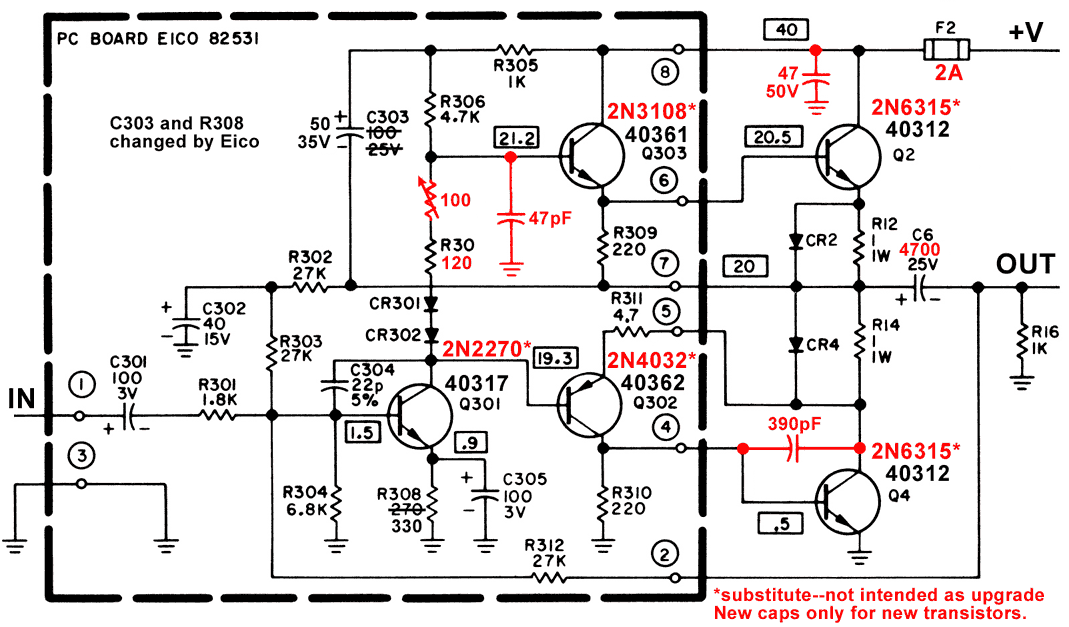
With the new drivers and output transistors installed, the Cortina was plagued by a large, 4Vpp, 10MHz oscillation on the output. This was due to instabilities in the Darlington output circuits. The higher Ft of the new output  transistors (4MHz versus 0.75MHz for 40312) was causing the problem. That was solved by adding the 47pF (above right) and 390pF (below), high frequency stability caps, seen in the modified schematic at left. Notice also the new 47uF bypass cap (below right) to provide high frequency bypassing, close to the output stage. It should have short leads and be located near Q2. transistors (4MHz versus 0.75MHz for 40312) was causing the problem. That was solved by adding the 47pF (above right) and 390pF (below), high frequency stability caps, seen in the modified schematic at left. Notice also the new 47uF bypass cap (below right) to provide high frequency bypassing, close to the output stage. It should have short leads and be located near Q2.
Though I had not intended to upgrade the amp with the new transistors, the higher beta and Ft have a prominent effect on performance, as you shall see.
I found a good match for the bad, PNP, TO-39 driver at Mouser, for just $1.43 each. To make sure that I would have everything needed to fix and maintain the amp, I also found good replacements for the other transistors in the power amp. The 2N3391A transistors used in the low level parts of the amp are readily available. Here is the list for the power amp:
|
Original
|
Description
|
Replacement
|
Source
|
|
40312
|
NPN power output
|
2N6315
|
Quest Compon.
|
|
40362
|
PNP driver
|
2N4032
|
Mouser
|
|
40361
|
NPN driver
|
2N3108
|
Mouser
|
|
40317
|
NPN voltage amp
|
2N2270
|
Mouser
|
|
Reapplying Heatsink Grease
 By the way, in working with the 3070, I noticed that the output transistors seemed to be getting unusually hot with respect to the nearby case, to which they are mounted. In replacing bad ones, I found out why: As seen at right, the heatsink grease (what little had been applied) seems to have deteriorated. By the way, in working with the 3070, I noticed that the output transistors seemed to be getting unusually hot with respect to the nearby case, to which they are mounted. In replacing bad ones, I found out why: As seen at right, the heatsink grease (what little had been applied) seems to have deteriorated.  I highly recommend pulling out all four output transistors and cleaning the chassis, transistor bottoms and both sides of the mica insulators, with a Scotch-Brite scrubbing pad and 409 (at left). Be very careful with the insulators, as they are quite fragile. After cleaning, apply new grease to the bottom of the transistor. Press the insulator onto the bottom and then apply grease to the bottom of the insulator. After remounting the transistors, I could no longer detect a significant difference in temperature between them and nearby chassis. This is an important measure to insure the longevity of the output transistors. I highly recommend pulling out all four output transistors and cleaning the chassis, transistor bottoms and both sides of the mica insulators, with a Scotch-Brite scrubbing pad and 409 (at left). Be very careful with the insulators, as they are quite fragile. After cleaning, apply new grease to the bottom of the transistor. Press the insulator onto the bottom and then apply grease to the bottom of the insulator. After remounting the transistors, I could no longer detect a significant difference in temperature between them and nearby chassis. This is an important measure to insure the longevity of the output transistors.
Low Frequency Stability Problem
With the new output and driver transistors (and high frequency stability caps), the amp is very solid. It drives capacitive loads with almost no overshoot. A 10kHz square wave into 4 or 8ohms looks perfect, with no overshoot or ringing at all. However, I did find a major issue with low frequency stability. To be fair to Eico, I have to say that it was made worse by a 50% increase in the emitter bypass cap (C305, below right) of the gain stage, due perhaps to loose tolerance.
There are two zeros (highpass filters) in the feedback loop: that cap and the output coupling cap. The emitter cap is supposed to be the dominant one, bringing the loop gain down before the frequency is low enough for the phase shift of the other one to kick in. Increasing the emitter cap spoils that strategy. I also note that Eico changed the value of the emitter resistor, increasing it, which also made the issue worse. With a 4ohm load present, I saw about 10dB of peaking at around 7Hz!
Replacing the emitter cap and increasing the output coupling cap from 2000uF to 4700uF fixed it, bringing the peaking down to 1.4dB or so. It’s only 0.3dB at 20Hz. No doubt, AC coupling in the line stages will eliminate it all.
Eico could have fixed the peaking by reducing C305. However, that would have reduced low frequency loop gain, resulting in more distortion. Increasing the output coupling cap fixes the peaking, without increasing distortion. Since the output coupling caps are relatively expensive, one could view this choice as an effort to keep the cost down, while maintaining distortion specs. Yet, the 10dB peaking at 7Hz could have exacerbated low frequency noise produced by tonearm resonance. That could have caused excessive movement of woofer cones and sapped power.
Excessive Output Stage Bias Current
But I wasn’t done yet. I noticed that after the output stage heats up with high output level, the quiescent bias current (Iq) in the output transistors could be as high as 160mA. I’m used to seeing something like 20mA, from dealing with audio power amps in the old days. The high value was dissipating over 7W in the output stage, which is comparable to the expected high-power dissipation! Instead of 220ohm resistor R307, I installed a 100ohm pot (secured with a small amount of 5-minute epoxy) and a 120ohm resistor in the bias string to reduce and adjust Iq (above right). Set it to an initial 20mA, which rises to 25mA as it warms up. After lots of output power into 4ohms, it can be as high as 50mA or so, a big improvement.
Getting the Right Channel Working
After replacing a few caps, I was able to get the right channel of the amp working pretty well. I added the Iq adjustment for the output stage. Output power is 16.8W, just below clipping. It beats the spec of 15W at 1% dist, achieving it with 0.63%. That drops to 0.33% at half voltage. To my relief, the transistors didn’t get too hot in regular testing, in spite of simply using the internal chassis as the only heatsink. The 3070 is significantly smaller than even its big brother, the 3150 (which is also quite small) and that is starting to grow on me. It’s really quite handy.
Yet, (unlike the 3150) I can’t use the 3070 as a lab utility amp, due to the lack of current limiting. Too much chance that something would happen. On the other hand, once it is safely ensconced in a stereo system, there really wouldn’t be much need for the protection. I considered adding it (as I did for the Heath AA-21) but it would materially alter the existing circuit. The five-transistor power amp design was all about simplicity, so I decided to keep it that way.
|
|
 |
|
Page-1
|
|
|
|
|
|
Continued on the next page:
Line Stage Noise Mod
|
|
|
|